
Languages & right-to-left
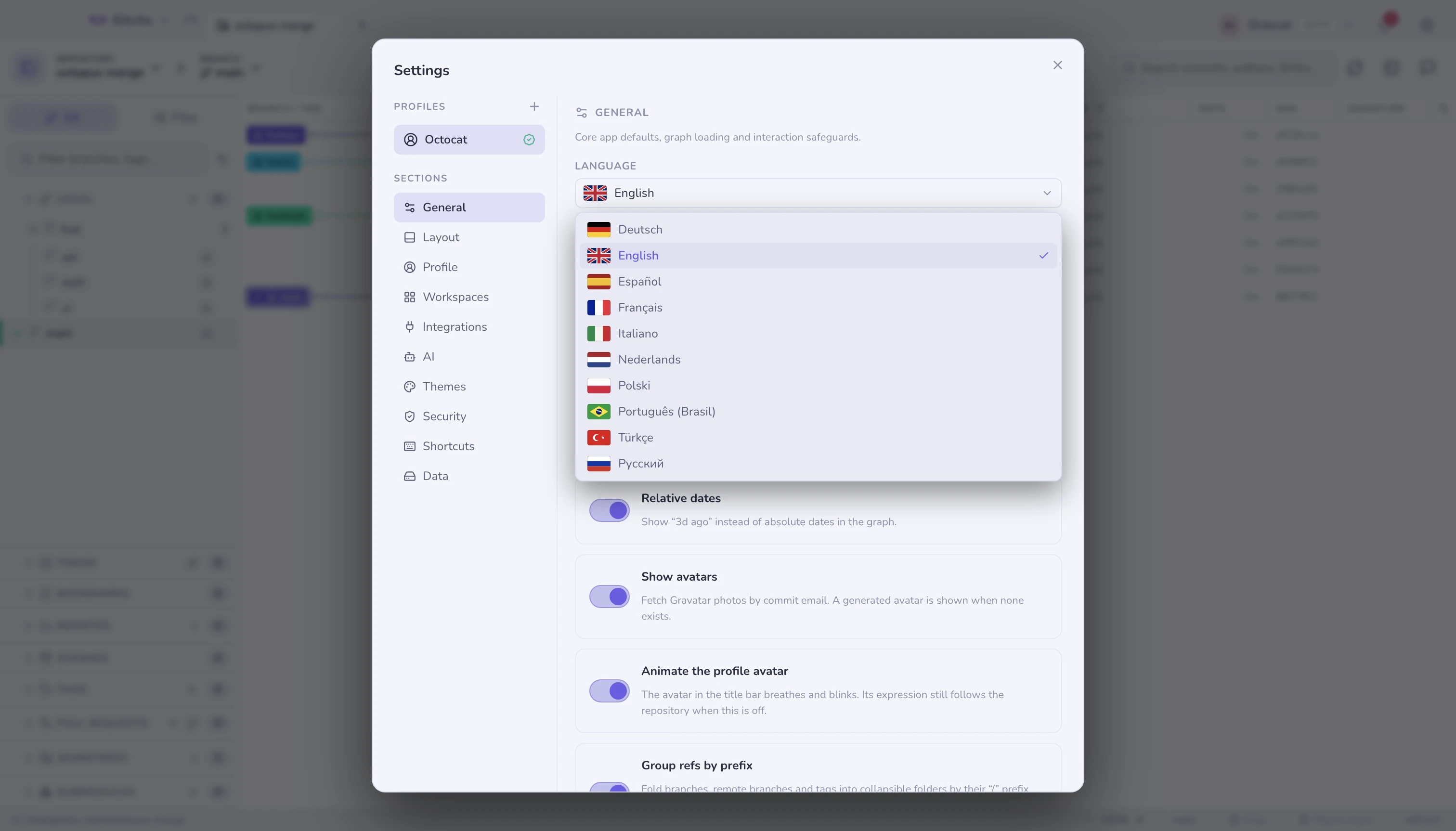
Gitcito's interface is translated. The language is a Gitcito setting, not an OS one — a developer on an English macOS install who would rather read Japanese sets it here, and a developer on a Hebrew system who prefers the app in English is not overruled.
Settings → General → Language.
What ships
| English | Español | Deutsch | Français |
| Português (Brasil) | Italiano | Nederlands | Polski |
| Türkçe | Русский | Українська | 简体中文 |
| 日本語 | 한국어 | العربية | עברית |
Each row in the picker is written in its own language. Someone looking for Korean is scanning for 한국어, not for the word "Korean" in a language they are trying to leave.
About the flags
A flag names a country; a locale names a language. The two genuinely do not line up — Arabic is an official language in more than twenty states, and Portuguese is on two continents. The icons follow the same convention every operating system's locale picker uses: the locale's primary region. They are there to be recognised at a glance, not to make a claim about who a language belongs to.
They are drawn as vector art rather than emoji on purpose. Windows ships no
flag emoji at all — 🇩🇪 renders there as a box containing the letters "DE".
Right-to-left
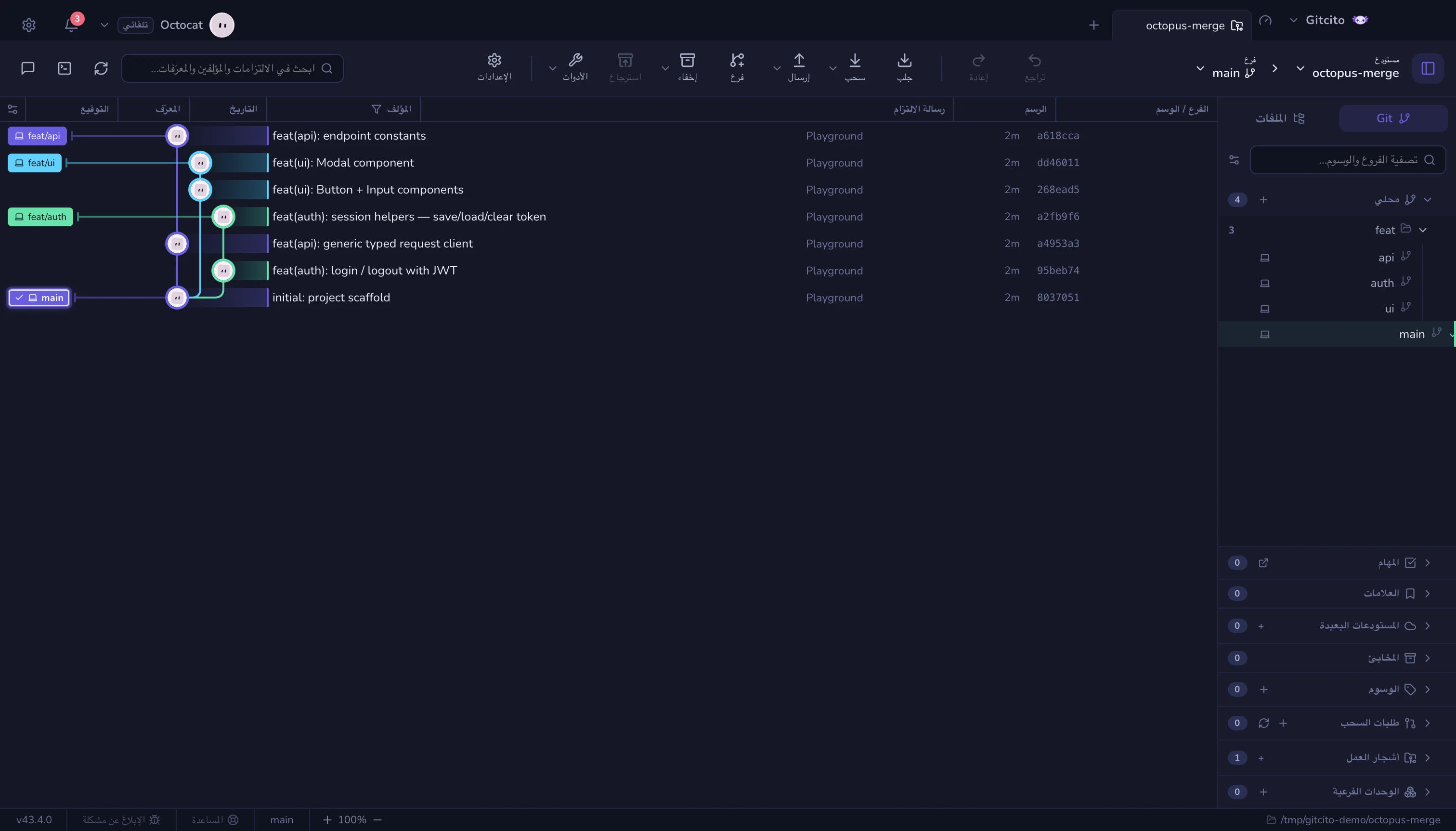
Arabic and Hebrew mirror the whole interface: the sidebar moves to the right, panels and toolbars reverse, icons that point somewhere point the other way.
Switching is immediate and needs no restart.
What deliberately does not mirror
Some content is left-to-right no matter what language you read. Mirroring it would be actively wrong, so these stay as they are:
| Stays LTR | Why |
|---|---|
| The commit graph | Lane positions are computed in pixels; a mirrored container would disagree with the drawn lines |
| Diffs and file contents | Code is LTR, and a mirrored diff is unreadable |
| Blame and the conflict output | Same reason — the text is source, not prose |
| The integrated terminal | It renders its own grid; git's output is LTR |
| Paths, SHAs, refs and commands | refs/heads/main reads in one direction only |
Each of these is isolated so a run of Arabic inside one — a branch name, a commit message, a filename — cannot reorder the text around it.
The limits
This is honest about where it stops:
- Commit messages, branch names and file contents are never re-directed by Gitcito. They are shown as their author wrote them. A Hebrew commit message in an LTR-isolated list renders as Hebrew, but the surrounding row does not flip to accommodate it.
- Third-party surfaces keep their own direction — the terminal is xterm, and Markdown previews render the document as written.
- Mixed-direction filenames are hard. A path with an Arabic folder inside an English tree is isolated rather than reordered, which is correct but can still look surprising the first time.
This handbook is translated too
Not just the buttons. Every page you are reading exists in every language the list above shows — the explanations, the tables of what each option does, the sections that say what a feature refuses to do. Switching the interface language switches the handbook with it, in the app and on the website alike.
A translation is allowed to be incomplete. If a page has not been translated yet, you get the English one rather than a missing page, and the sidebar keeps the same shape in every language so a screenshot or an instruction still lines up with what you see.
On the website each page carries a language switcher that keeps you on the page you were reading, because changing language is not the same as starting over.
What is machine-translated, and what that costs. English and Spanish were written by hand. The rest were translated by a model against a glossary, then checked by script: every page, every link, every image path, every code block byte-for-byte against the English. That catches broken structure. It does not catch a sentence that is correct but stiff. If a page reads badly in your language, that is a bug worth reporting.
Adding a language
The dictionaries are one file per locale under
src/renderer/src/i18n/, and the English file is the reference every other one
is type-checked against — a missing key is a compile error, not a silent
fallback to English. The test suite also checks that every {placeholder} a
string interpolates survives translation, so a sentence cannot lose its commit
sha on the way into another language.
The handbook works the same way: docs/help/ holds the English pages and
docs/help/<locale>/ holds each translation, one file per page with the same
filename. npm run lint:docs checks that every translated page has an English
original, that its front matter is complete, and that its links and images
resolve from one directory deeper.
Contributions are welcome — a page at a time is fine, and correcting a clumsy translation is as useful as adding a missing one.
See also: Themes & appearance · Profiles