
Teammate radar
You are editing api.ts. So is someone else, on a branch you have not looked
at. The usual way to find out is a merge conflict next week; the radar's way is
a list, today.
Everything is computed from your last fetch — remote-tracking refs, an
in-memory merge-tree, nothing else. No server, no agent on your teammates'
machines, no network beyond the fetch you were doing anyway.
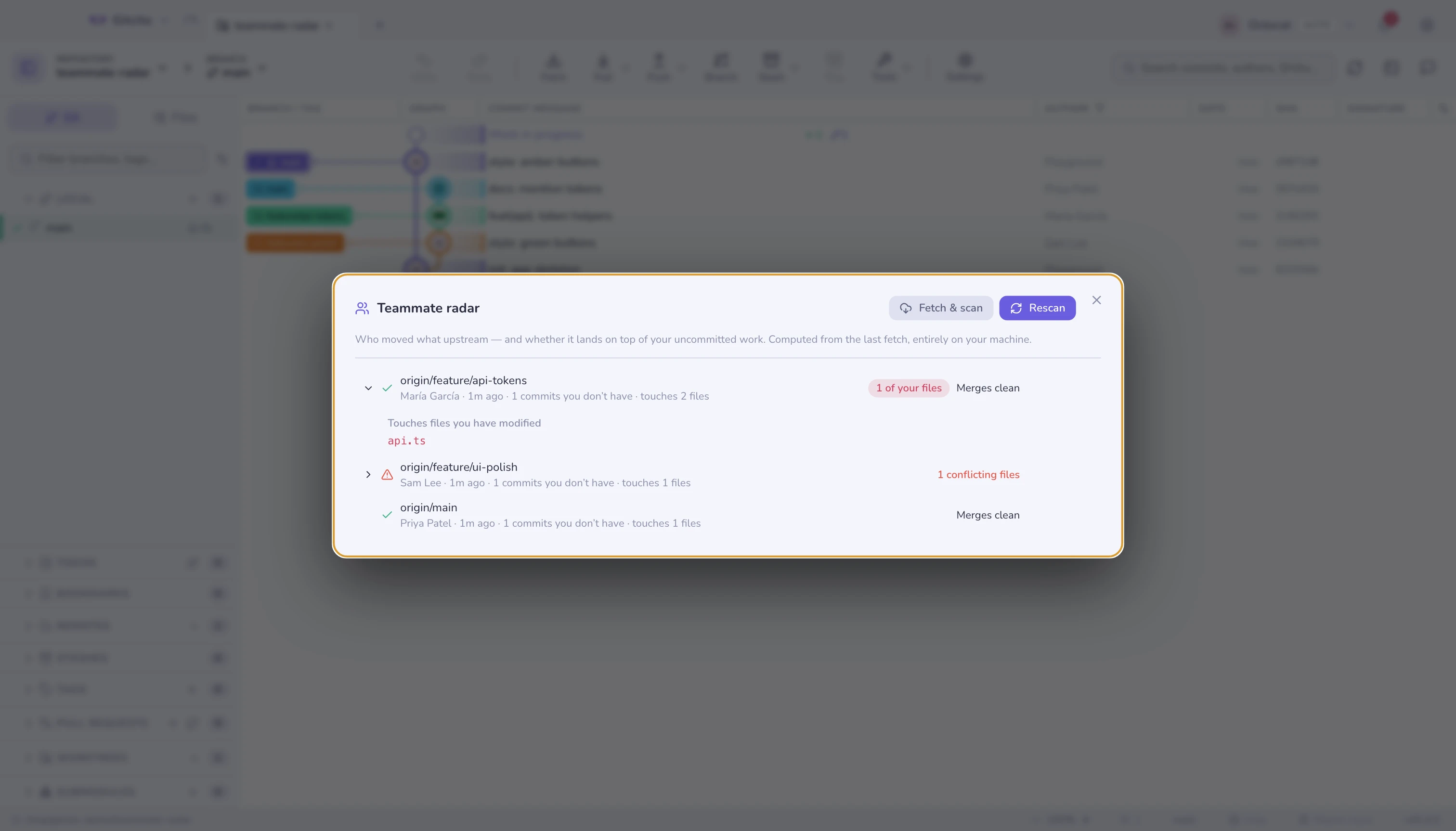
What a row tells you
For every remote branch that has commits your HEAD does not:
| Column | Meaning |
|---|---|
| Who & when | The last committer on that branch, and how long ago |
| Commits / files | How much is incoming, and how many files it touches |
| Overlap | Which of those files are dirty in your working tree right now — the red pill |
| Risk | Whether merging that branch into HEAD would conflict (same engine as the conflict radar) |
Rows are sorted by how much they collide with you: overlap first, then predicted conflicts, then recency. Expand a row for the exact file lists; Compare opens the full branch comparison.
When it speaks up
After every fetch — manual or automatic — the radar sweeps silently. It shows a toast only when upstream commits touch files you have modified and that set actually changed since the last sweep. No dirty files, no noise: a clean working tree cannot collide with anything.
Limits
- It sees what the last fetch saw. A teammate who has not pushed is invisible — this reads refs, not minds.
- Overlap is path-level, not line-level: touching the same file is a heads-up, not proof of a conflict. The Risk column is the line-level answer, but only between committed states.
- Branches idle for more than ~45 days are skipped, and only the 30 most recently moved are scanned.
See also: Conflict radar · Syncing · What changed since